The cult · the old sun
The oldest sun in Rome had a date and no stories.
No family, no face, no myth. One sacrifice a year, in August, on the Quirinal — and a word beside his name that the Romans themselves could not agree on.
§tradition — the cult; §result — the calendars, the editions, and what is inferred.
A sacrifice on the Quirinal
The Roman calendars are lists of days, and beside some days they say what is owed. On the ninth of August, three of the surviving calendars — the Amiternine, the Allifan and the Vallensian — record the same entry:
SOLI INDIGETI IN COLLE QUIRINALE · sacrificium publicum
— the Fasti for 9 August, as printed in W. Warde Fowler, The Roman Festivals of the Period of the Republic (1899)
To Sol Indiges, on the Quirinal: a public sacrifice. That is the whole of what the state calendar says about the sun. Not a story, not a hymn, not a genealogy: a date, a place, and the word publicum — paid for, performed, and owed by the city.
Two things sit behind that line. There was an ancient worship of the sun on the Quirinal, which the Romans believed to be Sabine — older than their own city, inherited from the hill's first inhabitants. And there was a pulvinar, the couch on which a god was set out to be feasted, close to the temple of Quirinus. The gens Aurelia were said to have had charge of the cult. A family kept it; the state paid for it; the city turned up once a year.
This is worth holding on to, because it is not how "sun worship" is supposed to look. There is no theology here, and no narrative — no chariot, no burning child, no descent. The Roman sun at home was not a god you told stories about. He was a god you turned up for.
The couch and the family
The pulvinar is the detail that makes the cult human. It was a couch — a real one, with cushions — on which the image of a god was set out so that the god could dine. The Romans fed their gods in public, at tables in the streets, and the pulvinar was the furniture of that idea: not a throne, a place at table. There was one for Sol on the Quirinal, beside the temple of Quirinus, and a family kept it.
That family, the gens Aurelia, is a thread worth pulling. A Roman cult was usually a college or a magistrate's duty; a gens holding one is older than that, closer to the household. And the hill itself is the second thread: the Romans believed the worship there was Sabine — inherited from the people who held the Quirinal before the city was one city. The Collis Agonus, the Quirinal's old name; the porta agonensis in its wall; the Salii agonenses, its own college of leaping priests. The old sun's address is a hill with its own vocabulary.
So before Rome was Rome, there was a sun on that hill with a couch and a family and a priesthood, and none of it left a story. When the city took the hill, it took the appointment and kept it.
The day
The ninth of August was an Agonium, and here the essay runs into the same wall a second time. The Romans did not know what the word meant either. Warde Fowler, who went through the evidence exhaustively, concludes that they knew neither the true form of the word nor its meaning; that Ovid's derivations "prove his entire ignorance"; and that the explanation still favoured by some — the sacrifice's ritual cry, agone?, "shall I slay?" — is quite uncertain.
What the sources can say is small and vivid. Festus gives Agonium as the name of the day and notes that agonia was an old word for the victim. Varro calls the day agonalis. There were four such days in the year — 9 January, 21 May, 17 March, 11 December — and nobody can show what connects them. A god Agonius, mentioned by Augustine, is probably an invention of the pontiffs: a name generated to fill a gap in a list.
And the word's only other traces are all on that same hill: the Collis Agonus, the gate, and the Salii. Which brings back the footnote from the last section — the cry Ozeul in the Salian hymn, and the Umbrian and Etruscan light-god Usil. The priests of the Colline city sang a word that nobody in the classical city could define, and the sun's name may be in it.
This is what the oldest layer of Roman religion actually looks like when you get close: not a myth, but vocabulary that has outlived its meaning, kept alive by people who turned up on the day and said the words because the words were the rite. The god's epithet is opaque. The day's name is opaque. The hymn is opaque. What survives is the appointment and the sound of it.
The word that would not settle
Sol Indiges — the sun indiges. The epithet is the difficulty, and it was a difficulty for the Romans too. Warde Fowler, gathering the evidence in 1899, puts it plainly: the Roman scholars themselves were not agreed, and the moderns have not done much better.
The ordinary ancient reading was that indiges means "of or belonging to a certain place" — a god fixed where he is, belonging to it by origin, protecting it. That is the meaning that survives in the Di Indigetes, the native gods, and it is the reading Wissowa came back to. On his account the word is almost a boundary marker: it says this sun, the one that belongs here.
The other reading takes indiges from indu and the root of agere: a god working in one particular act, business or place, and in no other. On that account the word is pontifical — a piece of priestly vocabulary of the same family as the indigitamenta, the lists of names used in invocation — and therefore not a survival from the oldest religion at all, but an administrative refinement. If that is right, then the oldest sun in Rome is wearing a name given to him by an office.
And then there is Preller's conjecture, which is the most attractive and the least provable. He took indiges as index — the one who points, who gives signs — and proposed that the name was not given to Sol until after the eclipse that followed the murder of Caesar. To support it he quoted Virgil:
“Sol tibi signa dabit. Solem quis dicere falsum / audeat? … Ille etiam exstincto miseratus Caesare Romam, / cum caput obscura nitidum ferrugine texit.”
— Virgil, Georgics i. 463–467: “The sun will give you signs. Who would dare call the sun a liar? … He too pitied Rome when Caesar was extinguished, when he veiled his shining head in rusty dark.”
On that reading the sun earns a name by failing — by going dark at the moment the republic did. It is a beautiful idea, and Warde Fowler's verdict is the right one: Preller may be right, and if he were, we should have no further trouble in this case. In other words: it cannot be shown.
What the glossaries say
The Latin dictionaries we have do not help as much as one would hope, and what they say is revealing. Festus, glossing the word, gives two senses and neither is about the sun:
“Indiges, indigetis. Hoc nomine Aeneas ab Ascanio appellatus est, quum pugnans cum Mezentio … Indigetes, dii quorum nomina non audebant proferre.”
— Festus, ed. Müller (1839): “Indiges: by this name Aeneas was called by Ascanius, when fighting with Mezentius … Indigetes: gods whose names they did not dare to utter.”
So the word in the glossaries belongs to a hero and to gods who may not be named. It is a word about belonging and about not saying. And there is a further thread Warde Fowler records in a footnote: the name has been connected with the Umbrian and Etruscan god of light, Usil — a word thought to be audible in Aurelius, and in the cry Ozeul in the hymn of the Salian priests. If that is right, the oldest sun in Rome was not called Sol at all. He had a name from before Latin.
Why the sun has no stories
Set the Roman sun beside the Greek and the difference is startling. Helios has a father, a sister, a palace in the east and a son who lost control of the horses. He sees everything and tells on people. He is a character.
Sol Indiges has a date. And the reason, I think, is not neglect. It is that the sun did not need explaining. Every other god needed a story because nobody could see him; the sun was there, every day, doing exactly what he had done the day before, and the only thing that needed doing about him was to keep the appointment. A myth is what you make when the thing itself is absent. Nobody made myths about the sun because nobody had to be told what it was.
That is why the calendar is the right monument to him, and the only one. A date is what attention looks like when it has nothing to say: be here, on this day, with this animal, at this place. The rite is the whole text.
The mark in the margin
Roman calendars do not only list days; they grade them. Beside each date stands a letter saying what may be done — F for a day when the courts sit, C when the assembly may meet, N when neither may, and NP, the mark of the great festivals of the people. The ninth of August carries NP in most of the calendars that survive; the Allifan has it as F. So the sun's day was not a private devotion or a priest's errand. It was one of the days the city stopped for.
That is a surprisingly large thing for a god with no stories. Whatever Sol Indiges was to the Romans, he was not marginal: the sacrifice was publicum, paid for out of the public purse, and the day was marked as one of the year's observances. A god can be silent and still be important — the calendar is a list of what a city will not forget.
What he looked like, if anything
The pulvinar implies an object: something was set on the couch to be feasted. But what? Here the evidence thins to almost nothing, and the honest answer is that we cannot say what stood on the Quirinal. The familiar sun of Roman art — the chariot, the radiate crown, the whip — is a Hellenistic figure, arriving with Greek craft and Greek gods; the older Italian sun is much harder to see, and the modern study of it (Hijmans, 2009) is largely an argument about how late the anthropomorphic Sol actually is.
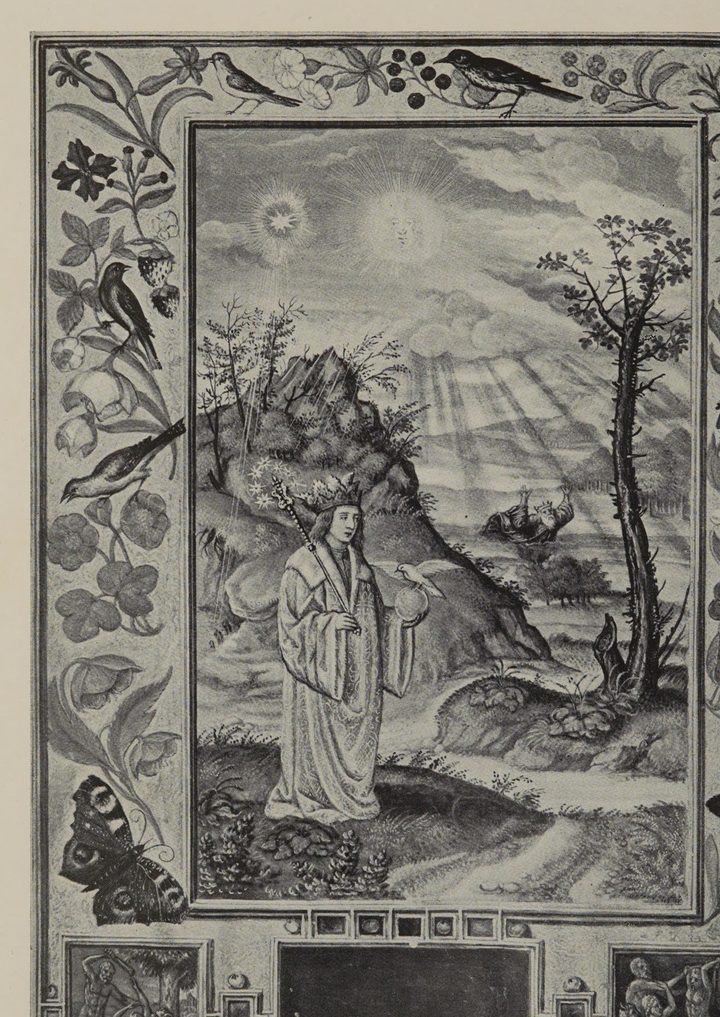
There is, though, one object the Romans did associate with the sun from early on, and it is not a person: the wheel. The sun as a disc, a rota, a thing that turns — that is older than the chariot and simpler than a face. A god you cannot picture is not a god you cannot honour; it may be a god you honour by turning up, with your hands empty.
The month around it
The day sits in a crowded fortnight. The month was Sextilis until 8 BC, when the senate renamed it for Augustus; around the sun's sacrifice fall the Furrinalia in late July, the festival of Diana on the Aventine a few days later, then the Consualia, the Vinalia and the Volturnalia — water, wine, the stored grain. The sun's date is not the solstice; it is the middle of the harvest, when the year's heat is doing its work and the barns are filling.
Which is, perhaps, the answer to the question of why this god has no myth. He did not need one. He had a season, and the season was full of other people's festivals, and his job was to be the thing all of it depended on.
The solar myth, and why we do not deal in them
There is a trap in this subject, and it is worth naming. In the nineteenth century it became fashionable to explain gods as suns: Max Müller's solar mythology, and the comparativists after him, found a sun behind almost every hero — the dragon is the dark, the maiden is the dawn, the golden apples are the year. Frazer's Golden Bough is the great monument of the habit, and it is on this shelf.
The habit had two faults. It explained everything, which is the same as explaining nothing; and it was built on etymologies that did not hold. The twentieth century took it apart, and the discipline that replaced it asks a simpler question: what did these people actually do?
Which is why this page has so little to say about what Sol Indiges meant and so much about what happened on the ninth of August. A god is not a symbol to be decoded; he is a date somebody kept. The moment we start calling every round thing solar we stop being able to see the one god who really was the sun — and he is right here, with a couch, a family, and a mark in the margin.
The last thing that happened to him
Then, slowly, two absorptions. First Apollo: as Greek religion came in, the sun became a god with a lyre, and the old one was a name in a calendar. Then, much later, the Syrian sun — the unconquered one, the black stone from Emesa — took the whole field, and the empire's sun was suddenly foreign.
And here the story turns, because that is when the old word does its last work. Wissowa's reading of Sol Indiges in the Julian calendar is that indiges was there precisely to distinguish the real, indigenous sun-god from the foreign solar deities who were arriving. The epithet was a hedge against the imports.
So the oldest god in the Roman pantheon ends as a distinguishing mark — a small word meaning ours, not theirs, attached to a sacrifice nobody had explained for six hundred years. The home sun becomes a way of telling the foreign sun apart. Not a grand ending.
Set the two side by side and the difference is the whole story of Roman religion in miniature. Invictus has a theology, a mystery, an emperor, a coinage, a date in December and a future — and he came from Emesa. Indiges has a hill, a couch, a family, a mark in the margin and a word nobody could define — and he was always there. One is a god you join. The other is a god you inherit.
What survives of him is not a story but a habit: a city keeping an appointment with the sun for six hundred years, on a date in the harvest, with a victim and a couch and a name it could no longer explain. That is what an old religion looks like from the inside — not belief, but practice that has outlasted its own reasons.
And there is something in it worth keeping, even at this distance. He was remembered for a very long time by people who could not have told you one thing about him. The remembering was the worship. Most of what we do for the dead is like this, and most of what we do for the light.
What we have
| Source | Date | What it gives | Trust |
|---|---|---|---|
| The Fasti (Amit., Allif., Vall.) | 1st c. BC–AD | the 9 August entry, Soli Indigeti in colle Quirinale | epigraphic, secure |
| Festus / Paulus, gloss | 2nd c. AD | Indiges = Aeneas; Indigetes = gods not to be named | antiquarian, reliable as a gloss |
| Varro, De lingua Latina | 1st c. BC | the sacra Argeorum and the Solis pulvinar (cited at second hand) | held; the sun passage is not legible in our copy |
| Macrobius, Saturnalia I | c. 430 | the late theology of Sol | antiquarian, not contemporary |
| Warde Fowler, Roman Festivals | 1899 | the calendars, the Sabine origin, the four readings of indiges | scholarly synthesis; the quotations above are taken from it |
What we do not have
Published null, twice over. We do not hold the Fasti themselves — CIL I² is not on the shelf, so the calendar entry is quoted from Warde Fowler's printing of it, which is honest but is not the stone. And the Varro passage (the pulvinar, from the sacra Argeorum) is known to us only as a citation in Warde Fowler's footnote: our copy of De lingua Latina does not carry it legibly. When CIL and a better Varro arrive, this page gets its own stone and its own sentence.