The gold
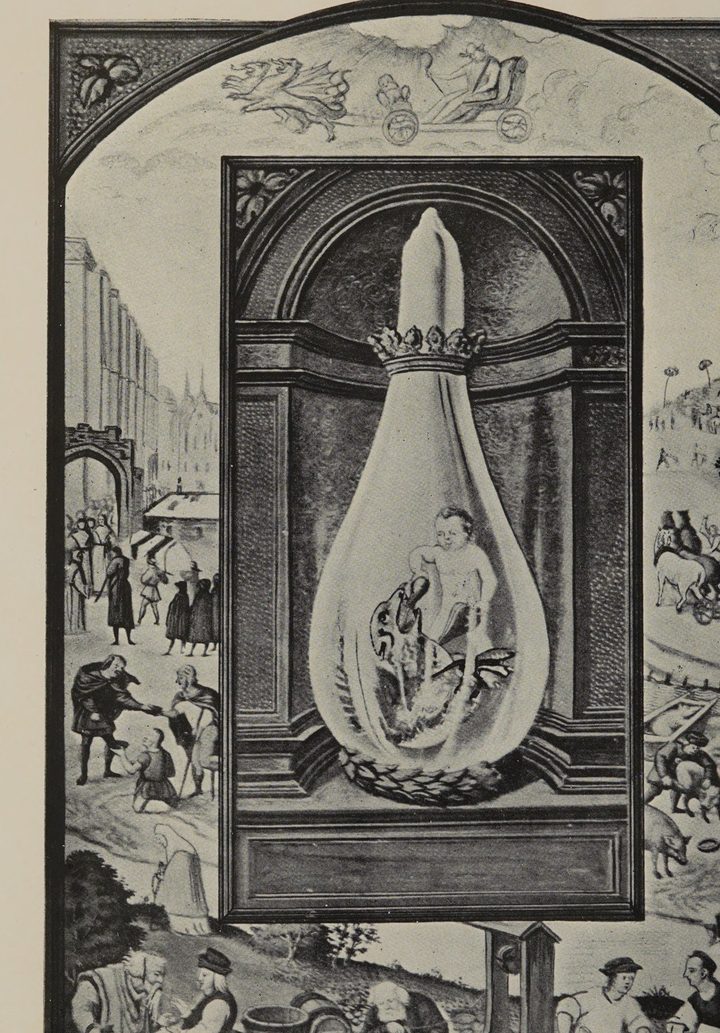
The sun in the flask.
The alchemists did not worship the sun. They put it in a vessel and worked on it — and that is a stranger thing to do to a god than to pray to it.
§tradition — the art and what it claimed; §result — editions and the one modern reading we hold.
“Its father is the sun”
The sentence that starts the whole tradition is short, and it is a genealogy. The Emerald Tablet — the Tabula Smaragdina, attributed to Hermes Trismegistus — opens by saying what the one thing is made of, in the language of parentage:
“The Father of that One Only Thing is the Sun; its Mother the Moon; the Wind carries it in his bosom, and its Nurse is the Spirituous Earth.”
— the Tabula Smaragdina, in the rendering given by H. P. Blavatsky, The Secret Doctrine (1888)
Father and mother: the sun and the moon. Not two gods to be asked for different things, but two principles that between them make one substance. Fulcanelli, describing the sundial at Edinburgh, calls the Tablet a thing “on which the solar Work was carved in cabalistic terms” — the solar Work, as though the sun were not the object of the craft but its subject.
Which is the shift this page is about. In the temple, the sun is above you and you are asking. In the workshop, the sun is in the material and you are working. The same word, and the relationship has been turned around.
Two suns
It is worth being precise about what alchemy meant by Sol, because it is not the thing in the sky. Sol is gold: the metal, the fixed and incorruptible body, the red. Luna is silver: the white, the volatile, the changing. The pair is not a myth about the heavens; it is a way of talking about matter and about the two halves of the work — the fixed and the fugitive, the husband and the wife, the red king and the white queen.
This is why the art could be Christian, pagan or neither, and why it survived every change of religion in Europe. It did not need the sun to be a god. It needed the sun to be a standard: the one thing in the world that does not rust, does not decay, and comes back every morning.
Why gold
Gold is the only metal that does not tarnish. Bury it, drown it, leave it in the air for a thousand years, and it comes out the colour it went in. Everything else corrodes; the sun, alone among the lights, returns. The identification is not arbitrary — it is a claim about incorruptibility, made twice in two different languages, one of them metallurgical.
And the promise follows: if the sun's quality is in gold, then a man who could make gold could make the sun's condition — permanence — available on earth. That is the whole ambition of the art, and it is not a small one. It is the wish to stop things ending.
The black sun
There is a counter-image, and it is the most striking thing in the whole tradition: sol niger, the black sun. It belongs to the nigredo, the first stage of the work, when everything in the vessel goes black and dies. Before the gold, the darkness; before the sun, its opposite. The alchemists drew it, and it has haunted the modern imagination ever since.
Published null: this shelf holds no primary text on the black sun. The sol niger we can quote is June Singer's modern account — “Saturn is also called Sol niger (the black sun) in alchemical literature … Nigredo is the place of Sol niger” (Androgyny, 1976) — which is a Jungian reading of the tradition, not the tradition. The emblem itself would need the primary texts, and they are not here.
The work
What did they actually do? The texts are deliberately obscure, and the obscurity is the point: the art was transmitted as a craft secret, written to be understood by someone who already knew, and it has cost centuries of readers a great deal of time. But the shape of the work is not mysterious at all. You took a substance, put it in a glass vessel, sealed it, and held it at a steady heat for a long time. You watched. You recorded what colour it turned.
The colours were the map. The scheme most often given runs from the nigredo — black, the death, the putrefaction — through the albedo, white, the washing and the return, to the rubedo, the red, the end. Sun and moon, black and white and red: the whole art is a story told in three colours, and the furnace is the plot.
Which is why the black sun belongs where it does. You cannot get to the red without the black; the tradition is unanimous about that, and it is the least fashionable thing it has to say. Everything in the vessel has to die first, and the death is not a metaphor for the alchemist's mood — it is a colour you can see through the glass.
The marriage
The other half of the story is a wedding. Sol and Luna are not simply two ingredients; they are a couple, and the central operation of the art — the coniunctio — is their union. The emblem books are full of it: a king and a queen, a red man and a white woman, sometimes in bed, sometimes in a bath, sometimes as the sun and moon with faces. The Atalanta Fugiens prints these as puzzles with a motto and a canon to be sung, so that the reader performs the argument as well as reading it.
There is a great deal of sex in alchemy, and it is not decoration. The claim underneath is that nothing is made alone: the fixed needs the volatile, the red needs the white, and the work is what happens when two things that will not combine are made to. Whether that is a statement about metals, about people, or about both at once is exactly the question the tradition refuses to settle — and the refusal is why it has lasted.
Why it is written like this
One more thing has to be said, because it explains the experience of reading these books. The obscurity is not an accident of bad writing or of the passage of time. It was a policy. The art claimed to be a secret held by few, and it wrote accordingly: the same substance under a dozen names, the same process as a king's journey or a bird's flight or a marriage, and no key anywhere. The result is a literature that can be read for a lifetime and never exhausted — and that can also be read by a charlatan for an afternoon and turned into a promise.
Both things happened, continuously, for four hundred years. Chaucer put an alchemist in the Canterbury Tales and made him a swindler; the popes banned the art and the kings employed it. None of that touches the question of whether the work was real, because the work was never only one thing: a chemistry, a philosophy, a con, and a way of talking about the soul, all in the same vessel.
The seven metals
The system that carried the sun into matter was astrology's, and it is worth setting out because it is the whole map at once. There were seven metals and seven planets, and they were the same seven things: gold was the Sun, silver the Moon, iron Mars, tin Jupiter, lead Saturn, copper Venus, quicksilver Mercury.
That is not a poetic comparison made afterwards. It was the working classification — the reason a recipe could say Sol and mean gold, and the reason the planet's character was expected in the metal. Saturn's lead is heavy, cold and slow because Saturn is; the Sun's gold is incorruptible because the sun does not fail. In a world organised this way, working with gold was working with the sun, and the furnace was a small sky.
It also explains what the art was for. If the metals are on a ladder with lead at the bottom and gold at the top, then the work is a climb — not the manufacture of a metal but the completion of one. The alchemists did not think they were inventing gold. They thought they were finishing what nature had left unfinished, and doing it faster, because they had the fire and nature did not.
Why the pictures
The art was transmitted as images as much as words, and the reason is practical: a picture can carry a process past a censor, a language barrier and a bad copyist. The emblem books are the result — the Splendor Solis with its illuminated plates, the Atalanta Fugiens with fifty emblems, a motto and a canon each, the Ripley Scroll drawn out over several metres. The plates on this page are from those books, and they are not illustrations of a text. In this tradition the picture frequently is the text.
Which is a warning as well as a pleasure. An emblem can be read a hundred ways, and has been. The pleasure of looking at these images is real — they are some of the most beautiful things made in early modern Europe — but a handsome picture is not an argument, and the art has been well served by people who forget that.
What the work left behind
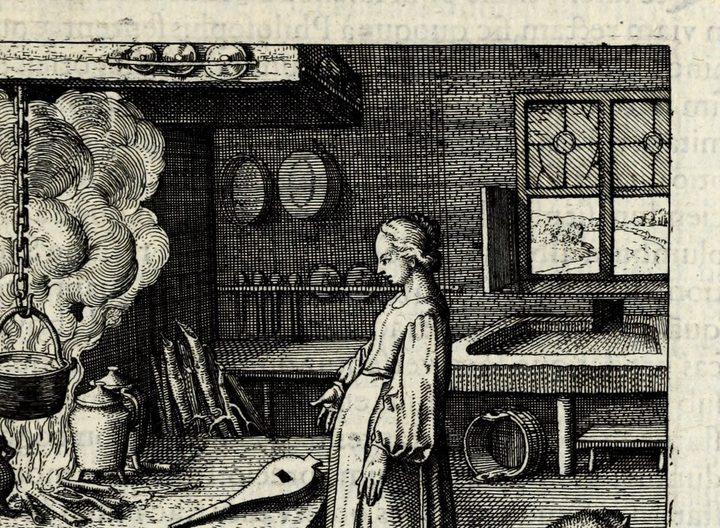
The alchemists did not make gold, and that is the least interesting thing about them. What they made was a method: a vessel, a fire held at a steady heat, a record of what happened, and the habit of asking what a substance is rather than what it is for. The furnace became the laboratory. The sun in the flask became the sun in the spectrum.
And then, in 1868, during an eclipse, a line appeared in the sun's spectrum that belonged to no known element on earth. They named it for the sun — helium, from helios — and it was another twenty-seven years before anyone found it in a mineral here. The alchemists wanted the sun's gold and were given its chemistry: the first element discovered on a star before it was discovered on the ground.
Which is, in the end, the old ambition satisfied in a form nobody asked for. The sun's substance is available on earth. It is in the air, in the rocks, in the balloon at a children's party. It simply turned out to be lighter than gold, and invisible, and free.
What we hold
The art, on this shelf: Artis Auriferae (the great sixteenth-century collection), Mylius' Opus Medico-Chymicum (1618), Splendor Solis, Atalanta Fugiens, the Aurora Consurgens, Fludd's Utriusque cosmi historia and the Ripley Scroll — with Fulcanelli's Mystery of the Cathedrals and Dwellings of the Philosophers in the sister programme. The plates on this page are from those books. The black sun is not, and the page says so.